


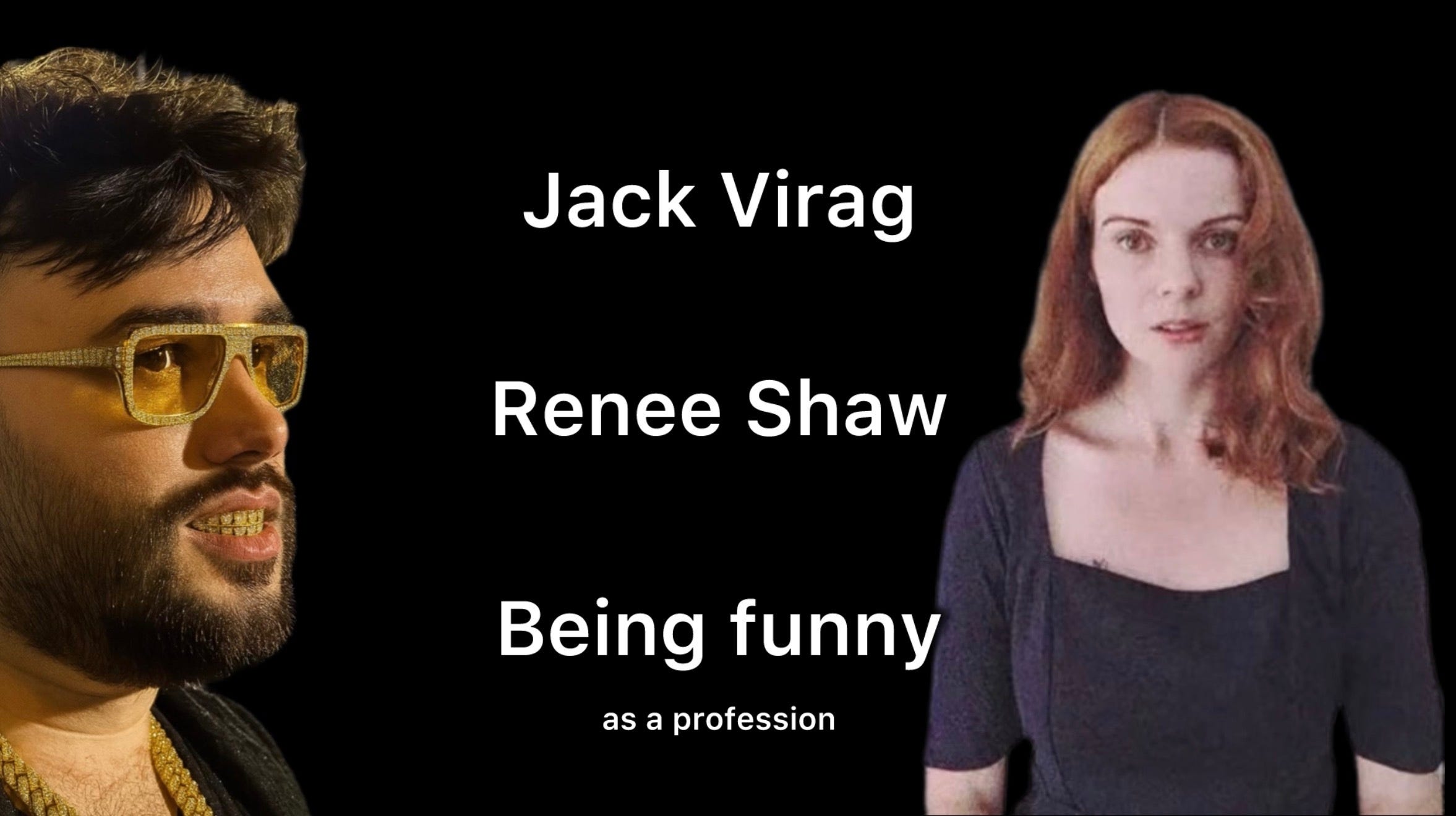
If you spend any time on LinkedIn, you know that every brand sounds the same. Every post feels like it was written by the same millennial commitee and/or fed through the same cringe AI.
Every now and then, especially if you’re following TL;DV, you’ll find something truly unhinged, like Renee Shaw declaring that the first step to hiring for a startup is downloading a dating app with the location set to SF.
I thought that was batshit insane, so I interviewed her—someone whose job it is to be funny on LinkedIn—to talk about humor, sanitized LinkedIn personas, and why brands are slowly waking up to the fact that sounding like everyone else is a losing strategy.
Underneath the jokes and memes, three things stood out to me.
Funny content often sits on top of a surprisingly serious content system.
The prevalence of AI-writing tools (and operators that aren’t very good at them) is expanding consumer appetite for humor and pattern-interrupting behavior—whether brands are ready or not.
The brands that win with humor understand something simple and intuitive: Being a real human online is a competitive advantage.
If you want to watch the full conversation, you can do it here. This article is my attempt to unpack what I learned.
1. Behind the chaos, there’s a real content engine
On the surface, Renee’s presence on LinkedIn looks chaotic. Skits, bits, strange analogies, very “Sarcasm as a Service” energy.
Under the hood, however, it’s weirdly disciplined.
Her process—which she shows in the interview—is a cycle that starts with capturing raw ideas anywhere they come up; shower thoughts. She then has a complete idea-to-production lifecycle:
Capture the idea in the moment
Tie it to a meeting, product capability, feature, if applicable
Create a rough draft
Get team feedback
Schedule the post far into the future
Let your future self decide whether it still deserves to exist
Anyone who publishes anything professionally understands this is insanely clever
After it goes live, track metrics, review what worked, and feed the learnings back into the next round
My favorite detail is the scheduling hack. I’ve often found that mood has a lot to do with our own self-critique: Something you’ve written in a fun mood might feel cringe when you re-read it in a serious mood.
The scheduling trick gives you the opportunity to really ask yourself if you’re okay with what’s being published. Maybe you’re not a fan, but is it worth redoing? The clock is ticking.
Interesting that Renee bakes it into the process.
What’s also baked into the process is feedback loops with coworkers:
Weekly calls where they go through drafts and sometimes spin them into full videos or posts
A shared internal language on Slack, with tags that signal things like “this is precious” or “final draft territory”
A willingness to ship reactive bits quickly, even against the CEO’s wishes (lmao) because there’s a lot of trust there
From the outside, I see Renee as “funny LinkedIn person,” but behind the scenes there are capture systems, psychological tricks, collaboration rituals, and metrics.
2. AI sameness is making humanity and humor a pattern-interrupt
At one point, our interview drifted into how everything on the internet is starting to sound the same.
B2B brands all seem to share the same writing style guide, the same brand voice, and the same structure. Functionally, the copy could be swapped between the companies and no one would notice.
Layer AI writing tools on top of that (with unskilled AI operators) and you get a new baseline of sameness. Everyone has access to “competent” and “optimized” and “[write a 1200-word SEO article about…]” content that reads like it was assembled by a team of sheepish millennial robots with quirky coffee mugs.
Against that backdrop, humor and pattern-interrupts aren’t just cute add-ons. They’re jabs. They’re a disruption.
Renee calls out a few trends she’s seeing:
The “always-anxious marketer” brand voice—brands role-playing as the relatable frazzled social media manager with a coffee and the “this is fine” meme as their desktop background.
A wave of companies trying to be the next Ryanair or Duolingo, copying tone without understanding why it works.
Corporate comedy that’s “funny” but safe to the point of being unremarkable and cringe. Jokes that punch down or lean into certain tropes because it feels edgy often backfire because no on wants to engage.
She also pointed out the meta-trend on LinkedIn itself: For a long time, only a handful of people were truly weird and funny and interesting. Now “weird LinkedIn” is its own aesthetic, and posts that used to be funny now feel like a (desperate) template:
“Unpopular opinions” that aren’t unpopular
“Hot takes” that are just like “yo attribution is tough”
Quirky, self-conscious one-liners that look like tweets from 2018
Once a format becomes recognizable, it becomes easy to produce, and easy to scroll past.
The irony is that as more brands adopt safe, corporate humor, the actual bar for differentiated humor keeps rising. The pattern interrupt that worked last year is now cringe.
Live by the meme, die by the meme.
What Renee and teams like hers are doing is treating humor as a scarce resource, asking:
Would we actually watch this?
Did any of us actually laugh at this?
If we didn’t make this, would we still think it’s good?
If the answer is no, they don’t post it—even if the AI says it’s a “high-performing hook” and the brand guidelines box is checked.
When AI can produce endless average content, the constraint moves from “can we ship enough?” to “can we ship something that feels like it has a pulse?”
3. Real humans are still the unfair advantage
Underneath all the jokes is a deeper point about being a person versus being a persona.
When I asked whether people bring their whole selves to LinkedIn, Renee’s answer was basically no. Most of us only show a sanitized fragment, for understandable reasons:
Psychological safety
Reputation management
Only sharing vulnerability that is spun to make us look admirable
We’ve all seen the same viral posts that follow the same emotional script, and while those moments are honest, they exist in isolation. LinkedIn is still “a professional platform.”
At work, though, the people who make the biggest impact are almost always the ones who show up as full humans.
I talked about this from my own experience: All my IRL friends are Statsig employees. My former manager Ben Goldstein is still basically my life advisor. None of this has anything to do with how well they did their jobs. It’s because of who they are as people. Not only are they now my network, but it also meant that they were impactful employees, easy to work with, etc.
When companies only get (or worse, encourage) the starchy and sanitized version of people, they miss huge chunks of their actual value. Like humor.
If you flatten yourself into whatever feels safest for a hypothetical hiring manager, you’re doing yourself a disservice by making yourself invisible to people who actually know how to spot talent.
Renee and TL;DV are playing a different game. Instead of just “doing jokes,” they’re letting real, messy traits leak into the content:
Spite and jealousy as creative fuel
Extremely specific cultural references that no AI would prioritize
The kind of self-deprecation and dark humor you only get from someone who’s very online and a little tired
An internal culture where she can pitch “This is a video where I pretend to snort coke” and doesn’t get fired
These make the brand feel like it’s staffed by actual people.
What to do with this if you’re a marketer
A few takeaways I’m sitting with after our chat:
Treat humor like a craft, not a lucky accident.
Build a content engine under it—idea capture, drafts, scheduling, review, metrics, internal language, trust. The chaos on the surface is supported by structure underneath.
Use AI for leverage, not for voice
Let AI help you with the outlines, research, and repurposing, but don’t let it define how you sound. If your brand voice becomes the average of what’s already out there, you’re cooked.
Let a more of your full self leak through
That doesn’t mean oversharing or turning LinkedIn into therapy, but you should be aware of when you’re sanding off your edges to look perfectly professional. The edges are often where the signal is.
Build internal trust so you can actually push the line
You can’t ship insane and unhinged content in a culture that freaks out when someone likes a post about work-life balance. If you want brave content externally, you need tolerance internally.
The short version is that everyone sounds the same on LinkedIn, but if you want to stand out, it actually takes quite a bit of technique.
Also, if you’re a fan of dry sarcasm and post-irony, you’ll like the full video. :)
Oh my gosh, my favorite LinkedIn person is here on Substack?? YAY! You should come on my podcast, The Daily Whatever Show!
damn